
CRM Consulting Services for UK Businesses
BhavPro provides CRM consulting services for UK businesses that need to select, improve or replace a CRM system. We assess workflows, data, user needs, platform fit, integration requirements, reporting and governance, then produce a practical CRM strategy and implementation roadmap before configuration, migration or development begins with clearer delivery priorities.
15+ Years Experience
Fully Remote
Flexible Engagement
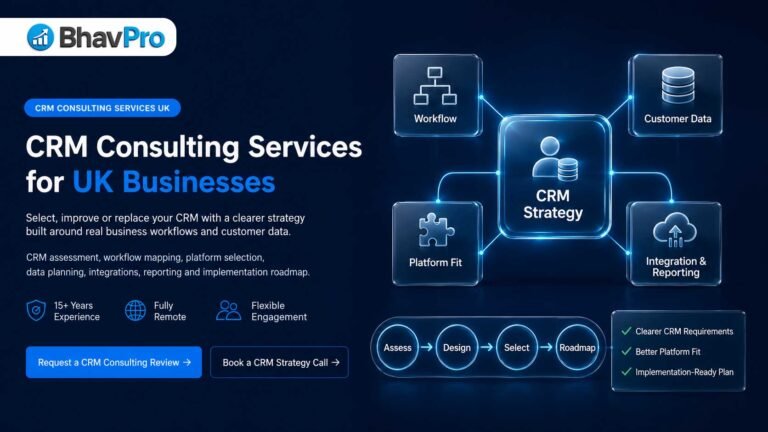
What CRM Consulting Services Include
CRM consulting should establish what the business needs before configuration, migration or development begins. BhavPro combines business-process discovery, CRM assessment, requirements definition, platform evaluation, data and integration planning, reporting design and governance into an implementation-ready roadmap.
CRM consulting is the strategy and decision layer. It helps a business understand its current processes, define the future CRM model, select or improve the right platform, identify integration and data requirements, and prepare a controlled implementation plan without assuming that new software is automatically the answer.
CRM Consulting vs CRM Implementation
BhavPro keeps advisory and implementation intent separate. Use consulting when the business still needs to decide what the CRM should do. Use implementation when the target design is sufficiently clear and the system needs to be configured, migrated, integrated, tested and launched.
| Requirement | Best BhavPro route | Why |
|---|---|---|
| Not sure which CRM or architecture is right | CRM Consulting | Clarify requirements, platform fit, risks and priorities before committing to delivery. |
| Current CRM is confusing, underused or no longer trusted | CRM Consulting | Audit the current state and decide whether to optimise, simplify, reconfigure or replace it. |
| Need workflows, fields, permissions and reporting defined | CRM Consulting | Create an agreed requirements and operating model before configuration starts. |
| Need CRM configured, data migrated or workflows built | CRM Implementation Services | This is delivery and build activity rather than advisory work. |
| Need bespoke CRM software or significant custom development | CRM Development & Integration | Custom application logic belongs to the development capability. |
When a Business Needs a CRM Consultant
CRM consulting is most useful when the underlying problem is broader than a missing field or one broken workflow. It helps teams make the right system decisions before time and budget are committed to implementation.
CRM Selection
You are comparing platforms and need a structured way to assess process fit, integration requirements, administration effort and future flexibility.
CRM Rescue
The current system contains useful data but teams avoid it, reports are unreliable, workflows are inconsistent or ownership is unclear.
Spreadsheet Replacement
Leads, customers, tasks or service records are spread across spreadsheets, inboxes and personal notes with no controlled system of record.
Growth & Complexity
The business has added people, services, locations or channels and the CRM no longer reflects how work actually moves between teams.
Integration Planning
CRM needs to connect with websites, VoIP, SMS, finance, support or operational systems and the dependencies need to be defined first.
Implementation Readiness
You have chosen a CRM but requirements, ownership, migration scope, testing criteria or acceptance conditions are not yet clear enough to build safely.
CRM Audit & Current-State Assessment
A useful CRM strategy starts with evidence. BhavPro reviews how the existing system, spreadsheets, inboxes, forms and connected tools are actually being used before recommending change.
What We Review
- Current CRM configuration and active modules
- Sales, service and customer-management workflows
- Fields, pipelines, ownership rules and data quality
- Reports, dashboards and management visibility
- Automation, notifications and hand-offs
- Website, VoIP, SMS, email and other integrations
- User adoption, admin ownership and recurring pain points
What the Review Produces
- Current-state findings and priority issues
- Processes that should be retained, simplified or redesigned
- Data and governance risks requiring attention
- Capability gaps versus business requirements
- Recommendation to optimise, reconfigure, replace or phase change
- Implementation dependencies and decision points
Already reviewing several business systems rather than CRM alone? BhavPro’s AI Business Systems Audit can assess the wider operating landscape before a CRM-specific programme is defined.
Business Process & Workflow Mapping
A CRM should reflect the way the business intends to operate, not force every team into default software stages. BhavPro maps the customer and operational journey before defining the future CRM structure.
Where enquiries originate, what information is required and who owns the first action.
Stages, decision points, responsibilities and evidence needed before an opportunity moves forward.
What should pass from sales into onboarding, project, service or account-management teams.
How future actions, service reviews, renewals and re-engagement should be visible and controlled.
The objective is not to automate every step. Human approval points and exceptions remain explicit where judgement or accountability is required.
CRM Requirements Definition
Requirements translate business needs into decisions an implementation team can actually configure, test and accept. BhavPro documents what the CRM needs to support without turning the specification into a feature wish list.
Functional Requirements
Records, pipelines, stages, fields, activities, tasks, templates, notifications, dashboards and operational workflows.
User & Role Requirements
Who needs access, what each role can view or change, ownership rules, approval points and administrative responsibilities.
Technical Requirements
Integrations, APIs, identity, data volumes, migration boundaries, environments, reporting dependencies and non-functional constraints.
Data Requirements
Required records, relationships, reference data, data quality rules, retention considerations and migration priorities.
Governance Requirements
Change control, permission ownership, field creation rules, documentation, auditability and operational handover.
Acceptance Requirements
What needs to be demonstrated before a workflow, migration, dashboard or release is treated as ready for use.
CRM Platform Selection & Fit Assessment
Platform selection should start with operating requirements, not a list of popular software names. BhavPro can structure comparisons around the capabilities, constraints and administration model that matter to your organisation.
| Evaluation area | Questions to answer |
|---|---|
| Process fit | Can the platform represent your real sales, service, account and renewal workflows without excessive workaround? |
| Data model | Does it support the records, relationships and custom information the business actually needs? |
| Integration | Are suitable native connectors, APIs or webhooks available for the systems that must remain connected? |
| Reporting | Can managers obtain the operational and commercial views required without uncontrolled spreadsheet exports? |
| Administration | Who will own the system after launch and how much specialist administration will routine change require? |
| Commercial fit | Do licensing, add-ons, implementation effort and likely future requirements fit the organisation’s expected operating model? |
Build, Buy, Optimise or Replace?
Not every CRM problem requires a new platform. Consulting should identify the least disruptive route that can satisfy the business requirement with an acceptable level of complexity and ownership.
Optimise Existing
Keep the current platform when the core product is suitable but configuration, data, workflows or governance need improvement.
Reconfigure
Restructure pipelines, fields, permissions, reports and workflows where the system has grown without a coherent operating model.
Replace
Move platform when material requirements cannot be met economically or the current CRM creates persistent operational constraints.
Custom Build
Consider bespoke development only where standard platforms cannot reasonably support the required business model or workflow. See CRM Development & Integration.
CRM Data Architecture & Information Design
CRM quality depends on more than the number of fields. The information model needs to make relationships, ownership and status understandable across the customer lifecycle.
Core Records
Define contacts, organisations, opportunities, tickets, subscriptions, projects or other records needed by the agreed operating model.
Relationships
Define how people, companies, deals, activities and service records connect so users and reports can follow the customer context.
Field Governance
Separate required business information from convenience fields and define who may add, rename or retire fields after launch.
Ownership
Clarify record owners, team visibility, assignment rules and what should happen when staff, territories or responsibilities change.
Reference Data
Standardise values such as services, lead sources, industries, lifecycle stages and reasons so reporting does not fragment.
History & Audit Context
Identify which interactions and changes need to remain available for operational continuity, support and accountable decision-making.
Data Quality & CRM Migration Readiness
Consulting can prepare a migration without pretending that importing a CSV is the whole migration. Source quality, field mapping, relationships, history, permissions and connected workflows all affect implementation risk.
Consulting Stage
- Identify source systems and data owners
- Define records and history that actually need to move
- Profile duplicates, missing values and inconsistent formats
- Plan field-to-field mapping and transformation rules
- Define reconciliation and acceptance expectations
- Document cutover dependencies and rollback considerations
Implementation Stage
- Clean and transform approved datasets
- Run pilot or staged imports
- Rebuild dependent workflows where required
- Validate record counts and relationships
- Complete user acceptance testing
- Execute cutover and post-migration validation
When migration is ready to execute, continue through CRM Implementation Services.
Sales Pipeline & Opportunity Design
A pipeline should represent meaningful buyer progress rather than internal activity labels. BhavPro can help define stages, ownership, required information and exit criteria so reporting reflects reality more reliably.
Entry Criteria
Define what qualifies a record to enter the pipeline and which information must be present first.
Stage Meaning
Use stages tied to observable commercial progress instead of vague labels that different users interpret differently.
Ownership & Handoffs
Define who owns each stage, how reassignment works and which actions must occur before handover.
Outcome Reasons
Capture useful win, loss, delay and disqualification reasons without creating an unmanageable list.
Customer Lifecycle, Service & Account Management
CRM does not have to stop when a deal is won. Consulting can define how customer context should pass into onboarding, delivery, support, account management and renewal without duplicating records across disconnected tools.
Onboarding Handover
Identify the information delivery teams need from sales and how accepted commitments, contacts and next actions should be transferred.
Service Context
Define how tickets, communications or service events should reference the customer record without forcing every operational process into the CRM.
Account Management
Plan review dates, key contacts, service history, opportunities and renewal signals where ongoing relationships matter.
CRM Integration Planning
Integration planning determines what data needs to move between systems, in which direction, at what point in the workflow and under whose ownership. The consulting stage defines the requirement before technical implementation begins.
Website & Lead Capture
Define how forms, campaign context, service interest and consent-related information should enter the CRM.
Business Applications
Map data exchange with finance, booking, support, SaaS, operations and other platforms. Where native connectors are insufficient, use API Integration Services.
Communication Systems
Plan how calls, messages and customer interactions should connect to CRM records without creating fragmented histories.
For telephone workflows specifically, see VoIP CRM Integration. For customer messaging requirements, see SMS Integration Services.
CRM Automation Opportunity Mapping
Automation should remove predictable administrative work without obscuring ownership or creating workflows nobody can explain. BhavPro identifies suitable automation opportunities and defines the conditions, exceptions and human approvals before build.
Good Automation Candidates
- Lead assignment using agreed rules
- Task creation after defined lifecycle events
- Internal notifications and escalation reminders
- Data enrichment or record updates from trusted sources
- Standard follow-up steps where timing and consent are appropriate
- Renewal or review reminders
Keep Human Control Where Needed
- Commercial judgement and complex qualification
- Sensitive customer communications
- High-impact approvals or exceptions
- Ambiguous data that requires interpretation
- Actions with legal, financial or reputational consequences
- Cases where the automation cannot fail safely
For broader workflow implementation beyond CRM, explore AI & Workflow Automation.
AI in CRM: Practical, Governed Use
AI can assist CRM work, but it should not be added simply because a platform has an AI feature. BhavPro assesses whether an AI-assisted step has a clear purpose, suitable data, acceptable risk and a defined human owner.
Draft concise account or interaction summaries where source data is sufficiently reliable.
Surface records requiring attention using defined criteria rather than opaque automation alone.
Help users prepare starting points for follow-up while keeping review and approval human-led.
Define where AI should not act, what data it may use and how outputs are reviewed.
If AI connectivity itself is the primary requirement, use AI Integration Advisory before implementation.
CRM Reporting, Dashboards & KPI Requirements
Reporting should be designed around management questions and operational decisions. BhavPro defines what needs to be measured, which fields support the calculation and who is accountable for data quality.
Pipeline Visibility
Open value, stage movement, age, ownership, next actions and reasons opportunities are won, lost or delayed.
Activity & Follow-Up
Useful activity coverage and overdue actions without turning raw call or email counts into misleading productivity metrics.
Source & Conversion
Where lead-source data is reliable, connect acquisition source with qualification and commercial outcomes.
Service & Retention
Track customer issues, review dates, renewals or service patterns where those workflows belong in the CRM model.
Data Quality
Monitor missing ownership, incomplete required fields, duplicate records and other issues that weaken management confidence.
Executive Views
Define concise management views rather than replicating every operational field in a large dashboard.
Permissions, Governance & CRM Ownership
A CRM becomes harder to manage when everybody can change everything. Consulting can define ownership, access and change rules before configuration grows into an uncontrolled environment.
Identify who is accountable for the CRM operating model, priorities and major change decisions.
Define who can change configuration, users, permissions, fields, workflows and integrations.
Assign ownership for pipelines, service processes, reporting definitions and required data.
Plan role-based access according to operational need rather than granting broad permissions by default.
Record significant configuration changes and test higher-risk updates before they affect live users.
Keep important fields, workflows, integrations, ownership and operating rules understandable after handover.
Privacy, Security & Compliance-Aware CRM Planning
CRM often contains personal, commercial and operational information. BhavPro can support privacy- and security-aware system design, but CRM consulting is not a substitute for legal advice, formal certification or a complete information-security programme.
Data Minimisation
Question fields and retained data that do not have a clear operational purpose rather than collecting information simply because the CRM allows it.
Access Control
Align permissions to responsibilities, reduce unnecessary administrative access and document sensitive workflows.
Retention & Ownership
Identify where retention decisions, deletion workflows and data ownership require business or legal input.
Where the requirement extends into wider governance, security controls or regulatory readiness, BhavPro can route the project into Compliance Advisory or relevant specialist support.
CRM Rescue & Existing-System Optimisation
A poor CRM experience does not automatically mean the platform is wrong. BhavPro can separate configuration problems, data problems, process problems and adoption problems before recommending a replacement.
Common Symptoms
- Teams maintain parallel spreadsheets
- Pipeline stages mean different things to different users
- Reports are questioned or rebuilt manually
- Automations create duplicate or unexpected actions
- Fields have accumulated without ownership
- Users cannot find the information needed for follow-up
- Integrations fail silently or create inconsistent records
Possible Recommendations
- Simplify the current configuration
- Redesign the lifecycle or pipeline
- Archive unused fields and workflows
- Improve data governance and reporting definitions
- Rebuild high-value automations
- Change licences or platform tier where justified
- Plan a controlled replacement only when necessary
CRM Vendor Evaluation & RFP Support
For larger selections, BhavPro can help turn business requirements into a structured vendor comparison or CRM request-for-proposal pack. The objective is to compare platforms against the same decision criteria rather than allowing each demonstration to define the agenda.
Business Objectives
Define the operating problems the CRM is expected to solve and how success will be recognised.
Requirements Matrix
Document functional, technical, integration, data, security, reporting and administration requirements.
Scoring Framework
Weight the criteria that matter most instead of treating every feature as equally important.
Demo Scenarios
Ask shortlisted vendors to demonstrate real business workflows rather than generic product tours.
Implementation Questions
Clarify migration, configuration, testing, training, support, ownership and future administration expectations.
Decision Record
Document trade-offs, unresolved dependencies and the reasons behind the preferred route.
CRM Platforms BhavPro Can Assess
Platform-fit work is requirements-led. Depending on the project, assessments can include established CRM products and the suitability of an existing or custom environment. BhavPro does not present vendor partnership status or certification unless it is specifically held and relevant to the engagement.
HubSpot
Sales, marketing, service and connected data requirements where HubSpot is already used or under consideration.
Zoho CRM
CRM and wider Zoho ecosystem fit, workflows, fields, automation and integration requirements.
Salesforce
Requirement and architecture review where Salesforce is an existing or shortlisted enterprise platform.
Pipedrive
Sales-pipeline focused requirements, workflow design, reporting and connected business processes.
Freshsales / Freshworks
Sales and service workflow assessment where Freshworks products are part of the operating stack.
Existing or Custom CRM
Current-state review and requirements analysis for bespoke, legacy or less common CRM environments.
Platform availability, features and licensing change over time. Final recommendations should be validated against the vendor’s current product and commercial terms.
CRM Consulting for Different Business Scenarios
Professional Services
Structure enquiries, organisations, matters or engagements, relationship ownership, follow-up and account visibility without forcing specialist delivery work into a sales-only model.
B2B Sales Teams
Define lead qualification, opportunity stages, territory or owner rules, follow-up requirements and management reporting.
Recruitment & Talent
Separate candidate, employer and commercial workflows where CRM must coexist with recruitment-specific systems and communications.
SaaS & Technology
Align leads, trials, accounts, renewals, customer-success signals and product or billing systems without duplicating ownership.
Service Businesses
Connect enquiry, quote, delivery, support and renewal context while keeping operational systems appropriately separated.
Remote & Multi-Team Operations
Clarify shared data, hand-offs, permissions, queues and ownership where teams work across locations or functions.
From Spreadsheets to a Controlled CRM
Moving from spreadsheets is not only a software decision. It changes ownership, data discipline, workflow visibility and how teams agree the source of truth.
Inventory
Identify spreadsheets, inboxes, forms and lists currently used to manage customers and work.
Standardise
Agree core records, statuses, ownership and common values before importing anything.
Design
Define the future workflow, permissions, reports and integration requirements.
Implement
Move into controlled configuration and migration after the requirements are approved.
Replacing an Existing CRM Without Losing Operational Context
CRM replacement should preserve useful business knowledge while removing the structures that caused the old system to fail. Consulting defines what needs to move, what should be redesigned and what should not be carried forward.
Preserve Deliberately
- Required customer and company records
- Useful relationship and activity history
- Commercially meaningful status and outcome data
- Compliance- or service-relevant records where applicable
- Working process rules that users genuinely rely on
Do Not Recreate Automatically
- Obsolete fields and duplicate values
- Legacy workflows nobody owns
- Reports that are no longer used
- Historical data with no agreed business purpose
- Workarounds created only because of old platform limitations
Scaling an Existing CRM for Growth
Growth often exposes weaknesses that were manageable when the team was smaller. CRM consulting can help redesign the operating model before additional users, markets or services make those weaknesses harder to unwind.
New teams need explicit permissions, queues, account ownership and hand-offs.
New products or services may require distinct pathways rather than one overloaded pipeline.
Finance, support, communications and operational platforms introduce additional dependencies.
Leaders need clearer definitions and consistent data as the organisation becomes harder to observe informally.
What You Receive From a CRM Consulting Engagement
Deliverables depend on the agreed scope. BhavPro can combine the following into a decision pack that is useful to business owners, internal administrators and implementation teams.
Current-State Review
Documented findings across process, platform, data, adoption, reporting and integration.
Workflow Map
Agreed future-state customer and operational journeys with ownership and decision points.
Requirements Catalogue
Functional, technical, data, reporting, integration, permission and governance requirements.
Platform Recommendation
Where selection is in scope, a fit assessment with trade-offs and unresolved considerations.
Data & Integration Plan
Source systems, migration boundaries, interfaces, ownership and implementation dependencies.
Implementation Roadmap
Priorities, phases, acceptance expectations, risks and the recommended route into configuration or development.
BhavPro CRM Consulting Process
The process is staged so recommendations can be challenged and agreed before implementation effort is committed.
Discovery & Objectives
Confirm business problems, stakeholders, systems, constraints, desired outcomes and the decisions the consulting work must support.
Current-State Evidence
Review workflows, configuration, data, reports, integrations and user pain points relevant to the agreed scope.
Future-State Design
Map target workflows, lifecycle stages, roles, data requirements, reporting and governance principles.
Platform & Architecture Decision
Assess whether the current platform should be improved or whether another route is justified.
Requirements & Dependencies
Document integration, migration, automation, permissions and acceptance requirements.
Roadmap & Handover
Prioritise work, identify unresolved decisions and prepare an implementation-ready sequence.
Implementation Route
Proceed with BhavPro implementation, another delivery partner or an internal team using the agreed consulting outputs.
Consulting Engagement Models
CRM Health Review
Suitable when you need an independent assessment of an existing CRM, a shortlist of priority problems and a recommendation for what to address next.
CRM Strategy & Selection
For organisations defining requirements, comparing platforms, planning future workflows and preparing a controlled implementation decision.
CRM Transformation Advisory
For multi-team programmes involving process redesign, data, integrations, governance, migration planning and phased implementation.
Final scope and commercial terms are defined from the actual systems, stakeholders, complexity and outputs required rather than a fixed package label alone.
How Long Does CRM Consulting Take?
There is no responsible fixed duration for every CRM consulting engagement. A focused review of one process can be materially smaller than a multi-team platform selection with migration, integration and governance requirements.
| Scope factor | Why it affects the engagement |
|---|---|
| Number of teams | More teams introduce additional workflows, permissions, hand-offs and decision-makers. |
| Current systems | Existing CRM, spreadsheets, legacy platforms and connected tools increase discovery and dependency work. |
| Data complexity | Multiple record types, poor data quality and historical migration requirements need additional analysis. |
| Selection requirement | Vendor research, demos and evaluation add decision stages beyond an internal optimisation review. |
| Governance | Regulated or tightly controlled environments may require more stakeholders, evidence and approval. |
CRM Consulting Cost & Scope
CRM consulting is quoted to scope because the value and effort depend on the decisions being made, the number of systems and stakeholders, the quality of existing information and the depth of deliverables required.
What Changes Cost
Stakeholder count, workflow complexity, platform comparison, data analysis, integration discovery, documentation depth and workshop requirements.
What a Quote Should Define
Objectives, activities, deliverables, assumptions, client responsibilities, exclusions, expected meetings and the handover point. Use the CRM ROI Calculator to model the business case and potential return assumptions before implementation.
Implementation Is Separate
Configuration, migration, integration build and go-live should be scoped separately once the advisory outputs are sufficiently clear.
What CRM Consulting Does Not Include by Default
Clear scope boundaries prevent advisory work from becoming an undefined implementation project. Unless specifically included in the written scope, CRM consulting does not automatically include the following.
- Full production CRM configuration
- Live data migration and cutover
- Custom API development
- Production automation build
- Custom software development
- Ongoing CRM administration
- Formal legal or regulatory certification
- Unlimited user training
- Third-party software licences
- Guaranteed sales, revenue or productivity outcomes
Where these requirements are confirmed, BhavPro can route them into the appropriate implementation or specialist service.
Relevant CRM Experience & Evidence Standard
BhavPro’s CRM consulting approach draws on cross-functional experience across CRM, VoIP, web systems, APIs, automation, customer workflows, reporting and business operations. That perspective helps identify dependencies that a platform-only review can miss.
Business First
Start with the operating problem and customer journey before changing software configuration.
Connected Systems View
Consider the CRM alongside websites, communications, automation, service and other business platforms.
Evidence Before Claims
Recommendations should be supported by observed workflows, system data, platform capability and agreed requirements—not anonymous performance percentages.
For the broader development and integration capability behind this work, explore CRM Development & Integration.
Which BhavPro CRM or Systems Service Do You Need?
| Primary requirement | Best route |
|---|---|
| Audit CRM, define requirements, compare platforms or create a roadmap | CRM Consulting Services — this page |
| Configure CRM, migrate data, build workflows, test and go live | CRM Implementation Services |
| Build or extend bespoke CRM functionality | CRM Development & Integration |
| Connect CRM with external platforms through APIs or webhooks | API Integration Services |
| Connect telephony and CRM workflows | VoIP CRM Integration |
| Connect SMS reminders, alerts or messaging with CRM | SMS Integration Services |
| Assess the wider business-system landscape before choosing a CRM route | AI Business Systems Audit |
Related CRM, Automation & Integration Services
Use these BhavPro pages when the requirement moves beyond advisory work into implementation, development or connected business systems.
CRM Implementation Services
Configuration, migration, workflows, testing, training and go-live.
CRM Development & Integration
Broader CRM development, custom logic and connected systems capability.
API Integration Services
Connect CRM with external platforms using appropriate APIs, webhooks and data flows.
VoIP CRM Integration
Plan and implement call workflows, caller context and CRM-linked communications.
SMS Integration Services
Connect reminders, alerts and two-way business messaging with CRM workflows.
AI & Workflow Automation
Implement wider business automation once the process and control model are clear.
AI Integration Advisory
Plan governed AI connectivity, data use and integration requirements before implementation.
Lead Generation Consulting
Connect acquisition, qualification and CRM hand-offs into a measurable lead-management process.
Sales Funnel Consulting
Align CRM stages, conversion paths and follow-up workflows with the wider sales funnel.
Frequently Asked Questions About CRM Consulting
Practical answers about CRM consulting, platform selection, audits, requirements, migration planning, implementation handover, integrations, governance and ongoing CRM improvement.
CRM consulting services help a business assess its current customer-management processes, define future requirements, evaluate platform fit, improve workflow and data design, plan integrations and reporting, and prepare a structured roadmap before implementation. The exact scope depends on whether the organisation is selecting a CRM, optimising an existing one or preparing a replacement.
CRM consulting defines what should be built and why: workflows, requirements, platform choice, data model, integrations, governance and roadmap. CRM implementation is the delivery stage where the approved design is configured, migrated, integrated, tested, trained and launched. BhavPro keeps these stages distinct so scope and accountability remain clear.
Yes. An existing CRM can be reviewed for workflow fit, data quality, pipeline design, reporting, permissions, automation, integrations and adoption. The recommendation may be to simplify or reconfigure the current platform rather than replace it.
Yes, where platform selection is included in scope. BhavPro can define requirements, build evaluation criteria, compare suitable options, structure vendor demonstrations and document trade-offs. Final platform decisions should also account for current vendor features, licensing, internal ownership and implementation capacity.
Depending on the project, assessments can include platforms such as HubSpot, Zoho CRM, Salesforce, Pipedrive, Freshsales or an existing/custom CRM environment. Platform selection remains requirements-led rather than assuming one product is right for every organisation.
Yes. Consulting can define the systems involved, data ownership, triggers, direction of data flow, frequency, error handling and business dependencies. Technical build can then move into API Integration Services, VoIP CRM Integration, SMS Integration Services or the CRM implementation scope as appropriate.
Consulting can define migration scope, source systems, data quality issues, field mapping, history requirements, validation expectations and cutover dependencies. Executing the migration itself is implementation work and should be separately scoped and tested.
Yes. CRM rescue and optimisation work can identify whether the main problems come from process design, data quality, configuration, governance, reporting, integrations or user adoption. That assessment helps avoid replacing a platform when targeted remediation would be more appropriate.
Timescale depends on the number of teams, workflows, systems, stakeholders and decisions involved. A focused health review can be relatively compact, while platform selection or a multi-team transformation roadmap can require several stages. BhavPro defines the expected scope and outputs before work begins rather than applying one fixed duration to every engagement.
Cost depends on scope, stakeholder count, current-system complexity, platform evaluation, data and integration discovery, workshops and documentation depth. BhavPro quotes against the agreed consulting outputs and separates implementation costs where configuration, migration or development will follow.
Training and ongoing administration can be included in an implementation or support scope where required. During consulting, BhavPro identifies adoption, ownership and training requirements so they can be planned properly rather than added at the end of a project.
Start by sharing the current CRM or spreadsheet setup, the main operational problem, the teams involved, any known integration requirements and what decision you need to make. BhavPro can then confirm whether a focused CRM review, strategy engagement or direct implementation route is the best next step.
Start With a CRM Consulting Review
Book a CRM Strategy Call
Discuss the current CRM, workflows and the decision you need to make before implementation.
Request a CRM Consulting Scope
Request a written CRM consulting scope based on your systems, stakeholders and required outputs.
Email BhavPro
Share your CRM challenge directly and BhavPro can advise the most appropriate next route.
If your CRM, spreadsheets or connected systems no longer reflect how the business works, BhavPro can review the current state, define the right consulting scope and identify whether the next step should be optimisation, platform selection or implementation.